 Seoul City Guide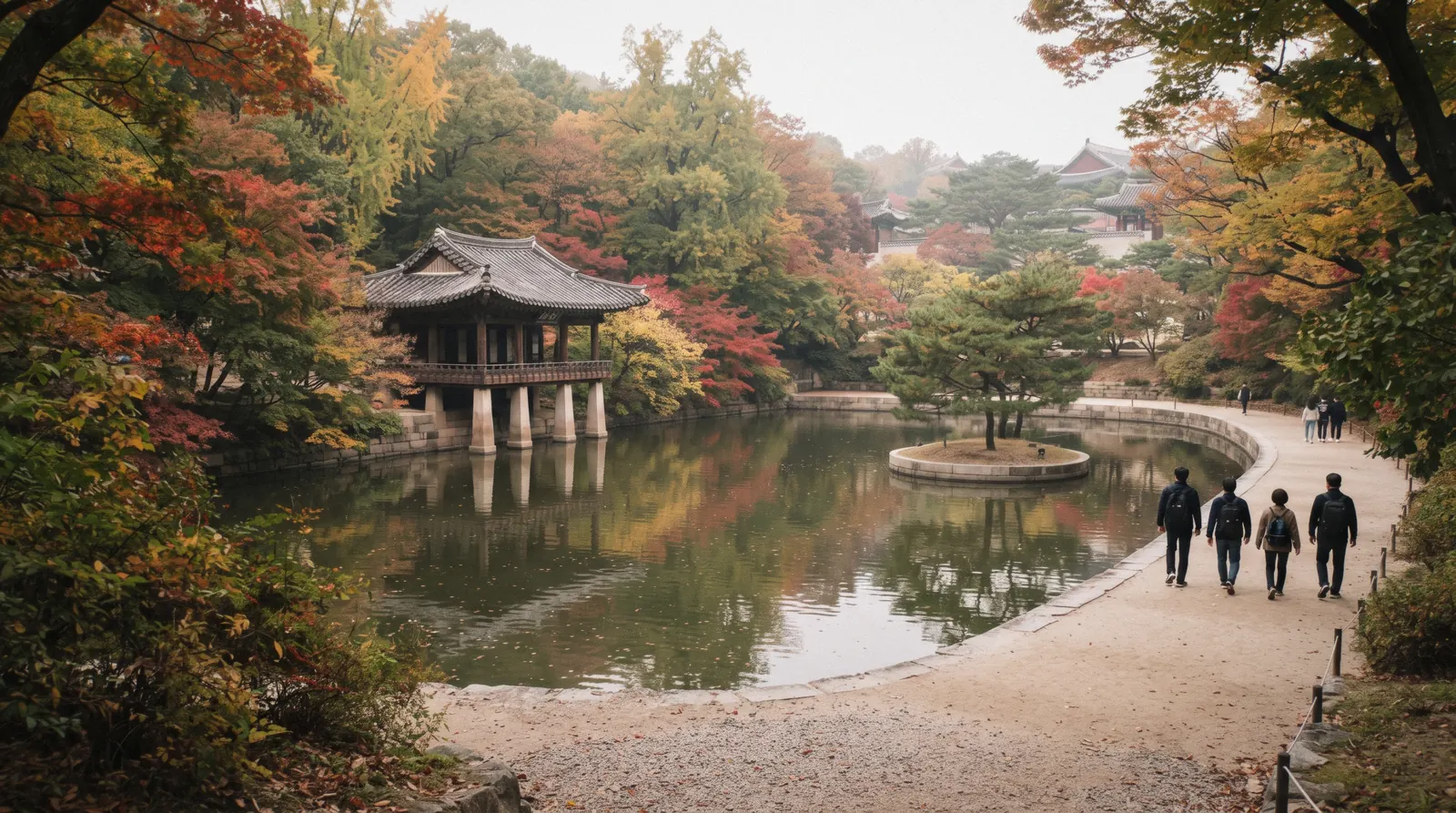
Changdeokgung Palace and the Huwon Garden
Changdeokgung Palace is the UNESCO-listed palace in central Seoul, and its Huwon garden runs on timed guided entry rather than open access. This page carries the palace and garden prices, the session times by language, the booking window and the Monday closure, checked in Q3 2026. Start from the Seoul city guide homepage if you are still choosing between palaces.
Quick answer Two tickets, one booked slot: how Changdeokgung actually works
Changdeokgung Palace is the UNESCO-listed one, and the palace Koreans send you to once you have done Gyeongbokgung. It splits into two visits: the palace grounds, which you walk freely for ₩3,000, and the Huwon — the rear garden, still called the Secret Garden in English — which costs another ₩5,000, runs on timed guided entry and is the reason to come. It closes on Mondays.
Key takeaways
- The Huwon sells 100 places a session: 50 online, opening at 10:00 six days before the visit, and 50 at the gate from 09:00 on the day. In October and April the online seats go in minutes.
- The English-language sessions are 10:30, 11:30 and 14:30 all year, with 15:30 added from March to November — you cannot join a Korean-language slot instead.
- The ₩6,000 integrated ticket covers the palace grounds here but never the Huwon, which is the single most common ticketing mistake in Seoul.
Key facts
Opening hours
| February to May, September, October | 09:00–18:00 |
|---|---|
| June to August | 09:00–18:30 |
| November to January | 09:00–17:30 |
Closed Every Monday. When a Monday is a public holiday the palace opens and the closure moves to the next non-holiday day.
Admission
- Adult
- Palace ₩3,000 (about $2.20); Huwon ₩5,000 (about $3.60) on top
- Reduced
- Huwon ₩2,500 for ages 7–18; the ₩5,000 Huwon fee applies to visitors 65 and over as well
- Free
- Palace grounds free in hanbok; the Huwon fee still applies
Planning it
- Time needed
- About an hour for the palace, plus a fixed 60–90 minutes for the guided Huwon walk
- Book ahead
- Essential — weeks ahead
- Address
- 99 Yulgok-ro, Jongno-gu, Seoul — Anguk (Line 3), Exit 3 — five minutes west to Donhwamun gate
Why This Is the Palace That Made the UNESCO List
Changdeokgung was built in 1405 as a secondary palace, and after the Imjin War it became the working seat of the Joseon court for some 270 years while Gyeongbokgung lay in ruins. It is the palace kings actually lived in longest, and the last members of the royal family stayed on in the Nakseonjae quarter into the late twentieth century.
UNESCO listed it in 1997 for a specific reason, and it is the reason you feel the difference within the first five minutes: where Gyeongbokgung is laid out on a rigid north–south axis, Changdeokgung follows the ground. Halls step around outcrops, courtyards bend, and the whole complex is fitted into the foot of the hills rather than imposed on them. Donhwamun, the main gate, dates from 1412 and is the oldest surviving palace gate in Seoul.
Injeongjeon is the throne hall, formal and bright; Seonjeongjeon behind it is the only palace building in the city still roofed in blue glazed tile. Nakseonjae, off to the east, is plainer than everything around it — unpainted wood, no dancheong colour — because it was built as a private residence, and it is the quietest corner of any palace in central Seoul.
Huwon Garden: Every Session, by Language
The rear garden is guided-entry only, with a fixed quota per session and separate timetables by language, exactly as published by the Korea Heritage Service and checked in Q3 2026. Korean nationals cannot enter a foreign-language session, though up to two may accompany a foreign visitor.
| Language | Season | Session times | Seats |
|---|---|---|---|
| English | March to November | 10:30, 11:30, 14:30, 15:30 | 100 per session — 50 online, 50 at the gate |
| English | December to February | 10:30, 11:30, 14:30 | 100 per session |
| Korean | March to October | Hourly, 10:00 to 16:00 | 100 per session |
| Japanese / Chinese | All year | Japanese 13:30 on Wednesday, Friday, Sunday; Chinese 12:30 on Tuesday, Thursday, Saturday | 100 per session |
Sessions leave on the minute from the Huwon entrance inside the palace — arriving late means missing it, and the ticket is not moved to a later walk.
How to Get a Huwon Ticket
Half of every session is sold online through the palace's own reservation system. Booking opens at 10:00 Korean time six days before the visit and closes the day before, first come first served. The other half goes on sale at the Huwon window inside the palace at 09:00 on the day itself.
That second channel is the one visitors overlook. If the online calendar shows nothing, a 09:00 arrival at Donhwamun still puts you in the queue for fifty places, and on a weekday outside peak season it usually works. In April, May, October and November it often does not — those are the months the Korea Heritage Service itself flags as selling out fastest, because the garden's ponds and maples are the point of the visit.
You must hold a palace ticket as well: the ₩5,000 Huwon fee is an addition, not a substitute, and the integrated palace ticket does not include it. Concessions work differently here too — the ₩5,000 rate applies to visitors aged 65 and over, who go free almost everywhere else in the palace system, while ages 7 to 18 pay ₩2,500.
What the Guided Walk Actually Covers
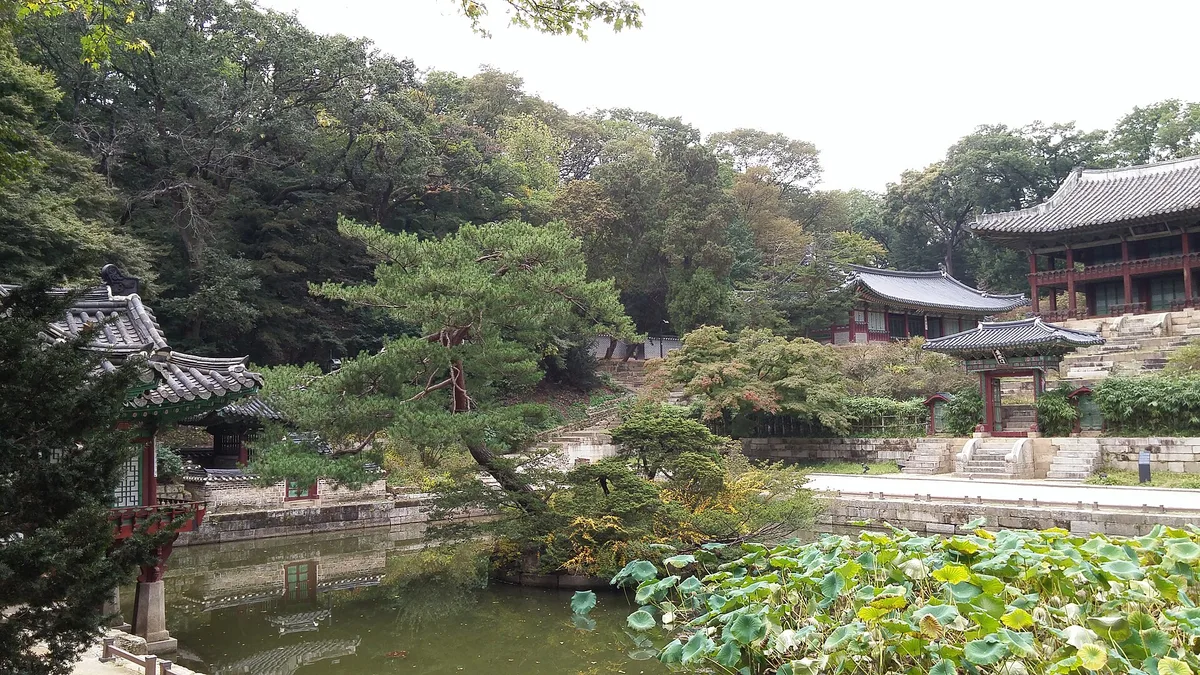
The walk runs sixty to ninety minutes on gravel paths with gentle climbs, and it is a set route with the group kept together.
It opens at Buyongji, the square pond with a round island — Confucian cosmology built as landscaping — with the Juhamnu pavilion above it, where Jeongjo housed the royal library. From there the path climbs to Aeryeonji and the small Yeongyeongdang residence, a nobleman's house built inside a palace so that a crown prince could see how commoners of rank lived. The far end of the walk reaches Ongnyucheon, a stream cut across a boulder into a circular channel for floating wine cups, with a poem carved above it.
What you do not get is freedom to wander. Everything past the entrance is on the guide's schedule, cameras are fine, and stepping off the path is not. In late October the maples along Aeryeonji are the reason the season sells out; in high summer the garden is green, still and mosquito-ridden.
Ways In, Official Window First
The palace and the garden are sold at the palace's own windows and its online reservation system; partner listings here buy a guide and a route rather than a shortcut, since there is no queue-skipping product for the Huwon. Gate prices read off royal.khs.go.kr and partner prices off GetYourGuide in Q3 2026.
| Option | Price | What it gets you | Cancel | Book |
|---|---|---|---|---|
| Palace ticket, Donhwamun window | ₩3,000 (about $2.20) | Palace grounds including Nakseonjae | Buy on the day | Official site |
| Huwon timed entry | ₩5,000 (about $3.60) plus the palace ticket | Guided 60–90 minute garden walk | Online seats open 10:00, six days ahead | Official site |
| Integrated palace ticket | ₩6,000 (about $4.30) | Five sites over six months — Huwon not included | No refund once a coupon is torn | Official site |
| Guided palace history walk | from $32 | 2.5 hours across the palace quarter with a guide | Free, 24 h before | Check Availability |
Official ticket-office links are not affiliate links.
Changdeokgung or Gyeongbokgung, If You Only Do One
Take Gyeongbokgung if this is a first, short visit to Seoul. It is bigger, it is free to walk into in hanbok, the guard ceremony is a genuine spectacle, and its two museums are free. It is also the more crowded and the more reconstructed.
Take Changdeokgung if you would rather have an hour in a garden than a morning in a courtyard, or if you are here in late October. The palace itself is a shorter visit than Gyeongbokgung, the Huwon is the best hour in any Seoul palace, and Nakseonjae is the only place in the system that feels lived in rather than staged.
Doing both in one day is realistic and about fifteen minutes apart on foot, but only in one order: book the Huwon slot first, then fit Gyeongbokgung around it, because the garden time is fixed and the other palace is not. Note also that they close on different days, so a two-palace day cannot be a Monday or a Tuesday.
How to Get There
Anguk station on Line 3, Exit 3, is five minutes' walk west along Yulgok-ro to Donhwamun. That exit also puts you at the bottom of Bukchon Hanok Village, so the standard morning is the village first while it is quiet, then the palace.
From Gyeongbokgung it is about fifteen minutes on foot along the palace wall. From Insadong it is ten minutes north. A metro ride costs ₩1,550 on a transport card; see getting around Seoul for the card and transfer rules.
The Palace Itself, in Under an Hour
Through Donhwamun the path swings right over the Geumcheongyo bridge — the oldest stone bridge in Seoul, carved with guardian animals under its arches to stop bad luck crossing the water. Injinmun leads into the throne-hall courtyard, where the rank stones step down the middle of the yard in two rows and Injeongjeon sits on its terrace at the top.
Behind it, Seonjeongjeon was the everyday office, and it is worth going round the side to look at the roof: blue glazed tiles, the only palace building in Seoul that still carries them, expensive enough in the fifteenth century that the court was criticised for it. Huijeongdang and Daejojeon beyond were rebuilt in the 1920s after a fire, and their interiors were fitted out with electric light, parquet and Western furniture, which is a strange and useful thing to see immediately after the throne hall.
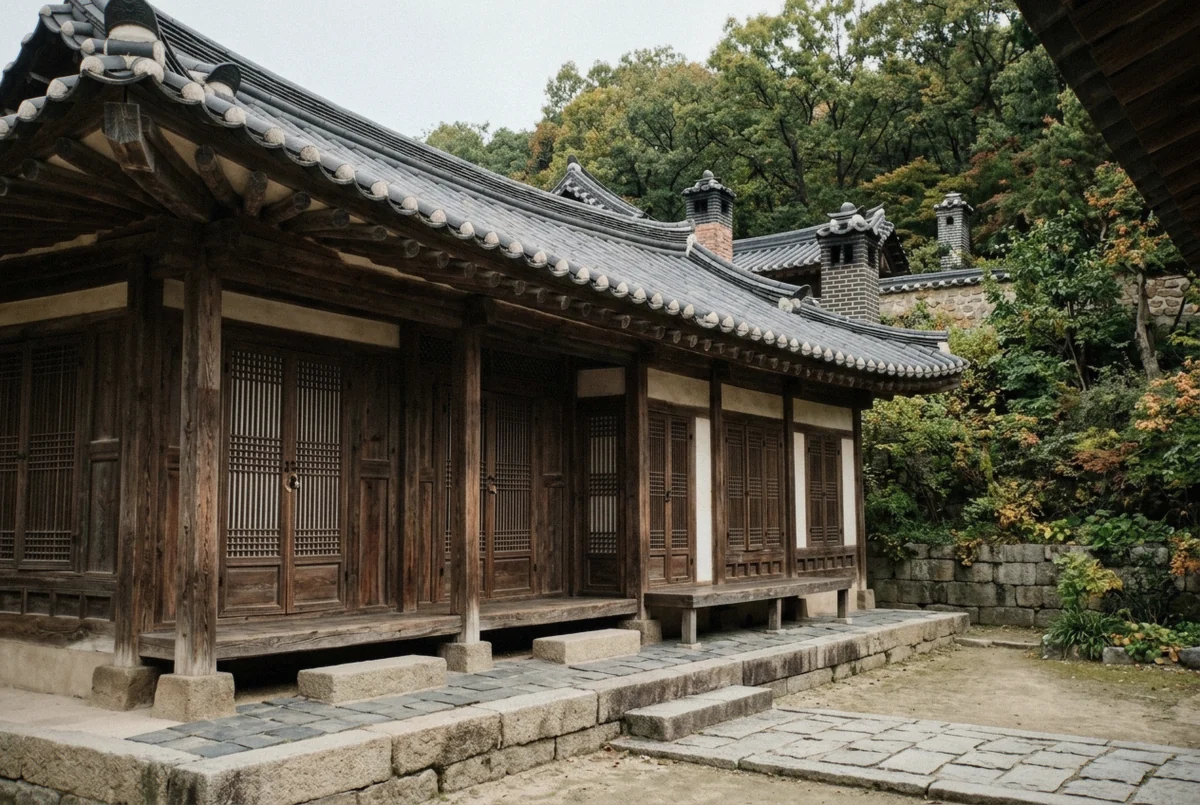
Nakseonjae is the last stop before the garden and the one people skip. Heonjong built it in 1847 for a concubine and left it deliberately unpainted — bare wood, latticework, a terraced back garden of chimneys and stone. The last Korean crown princess lived here until 1989. Give it fifteen minutes, and take the steps up behind the residence for the view back over the roofs.
When the Garden Is Worth the Extra Ticket
Late October and early November are the point of the Huwon: the maples around Aeryeonji and Buyongji turn, the light is low by three in the afternoon, and every online session goes within minutes of release. If you are in Seoul in those weeks, put the booking alarm at 10:00 exactly six days out.
April is the other peak, less for blossom than for the first green after a hard winter, and the Korea Heritage Service names both spring and autumn as the fast-selling seasons. Summer is available at short notice for good reason — the garden is humid, still, and full of mosquitoes — though a 10:30 session before the heat builds is genuinely pleasant. Winter is the quiet secret: the ponds freeze, the pavilions have nothing to hide behind, and the same-day fifty places are usually there for the taking.
Whatever the month, the palace itself takes a Monday off, and the wider closed-day pattern decides which day of a short trip this visit can occupy at all.
The Mistakes That Cost People the Garden
Three errors account for nearly every disappointed visitor at the Huwon window.
Buying only the integrated ticket. The ₩6,000 pass is excellent value across five sites, and it explicitly excludes this garden. You still pay ₩5,000 at the Huwon window.
Assuming the language sessions are interchangeable. They are not: the timetable is separate for English, Korean, Japanese and Chinese, and Korean nationals are not admitted to a foreign-language walk unless they are accompanying a foreign visitor, and then no more than two of them.
Arriving at 10:28 for a 10:30 session. Groups leave on time from inside the palace, which means you need to already be through the palace ticket gate and standing at the Huwon entrance — allow fifteen minutes between Donhwamun and the meeting point, more if you are buying the palace ticket at the same window as everyone else.
Practicalities: Paths, Time, Weather
The palace grounds are flat and largely accessible; the Huwon is not — it is a gravel garden with slopes and steps, and the guided pace does not wait. Visitors with limited mobility do better on the palace and Nakseonjae, both of which are level.
There is little shelter in the garden and the walk goes ahead in rain, so an umbrella matters more than a jacket. The palace ticket window and the Huwon window are separate; buy both before you cross the courtyard. Audio guides for the palace are rented near the entrance, and the free English commentary times are posted at the gate on the day.
For a first-time visitor doing one palace, the total cost with a garden slot is ₩8,000 — under $6 — which sits at the low end of the daily budget for anything in central Seoul.
Changdeokgung on the Map
Pinned at the entrance, with the pages for what is nearby.
Next Stop from Donhwamun
Three places within fifteen minutes on foot, in the order that fits around a booked garden slot.
Jongmyo Shrine
About 8 minutes south to Jongmyo, the royal ancestral shrine, which also runs on timed entry — and closes on Tuesdays, not Mondays.
8 min walkBukchon Hanok Village
About 8 minutes uphill to Bukchon Hanok Village; go before 11:00 or after 16:00.
8 min walkIkseon-dong
About 10 minutes south-east to Ikseon-dong, the hanok alleys turned into cafés — the obvious lunch after a morning slot.
10 min walkGuided Visits That Include This Palace
Listings that cover the palace quarter with a guide. None of them can sell you a Huwon place — that comes from the palace's own system — so read the itinerary before booking if the garden is what you want. Ratings and prices are the operators' own figures, checked in Q3 2026.
 from $32
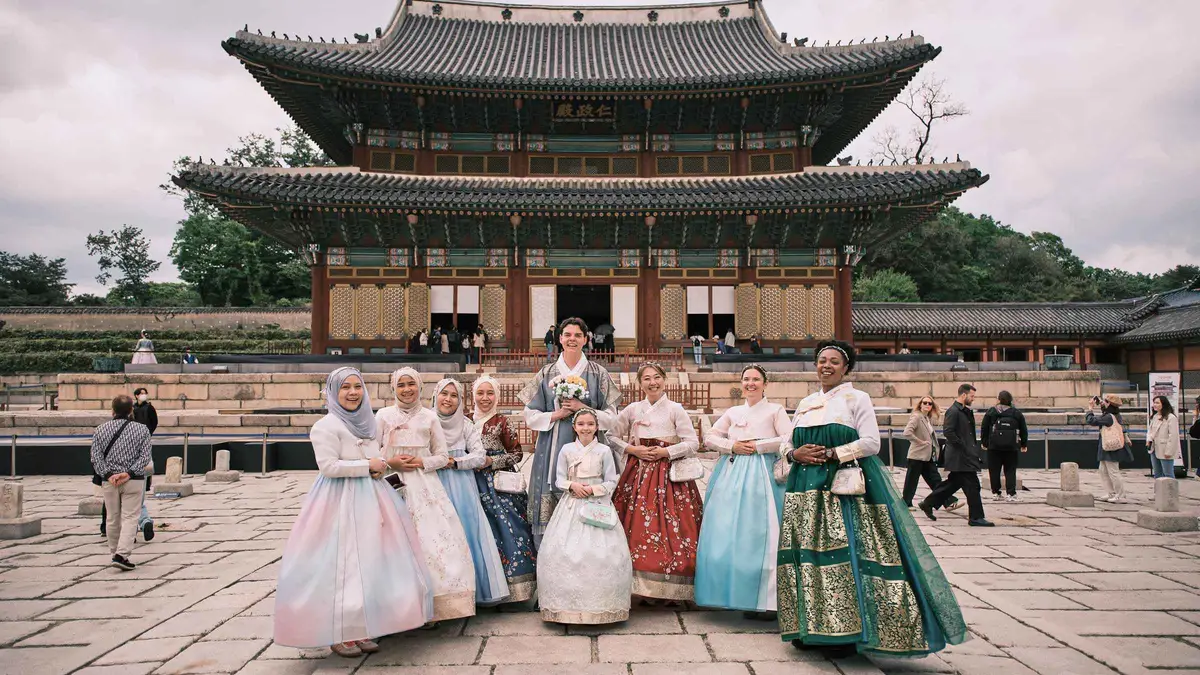
Seoul: UNESCO Palace History Tour, Photos & Optional Hanbok
Explore UNESCO-listed Changdeokgung with an English-speaking history guide. Discover royal stories, enjoy casual travel photos, and choose to enhance your experience with optional.
Check Availability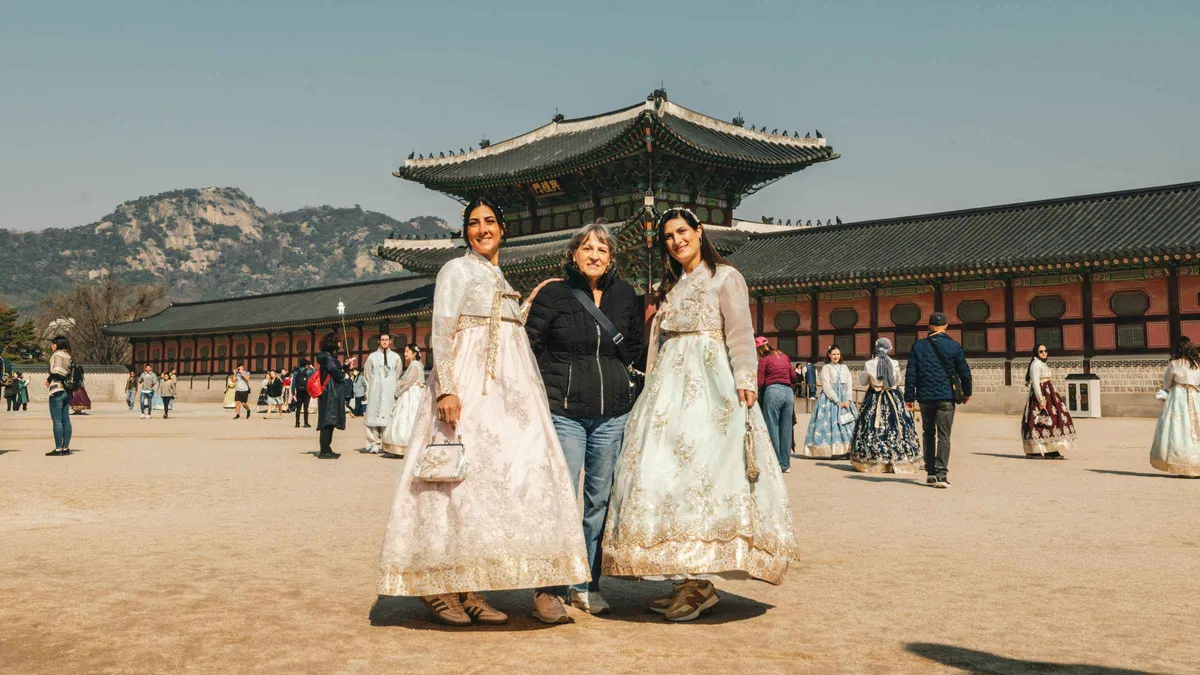 from $57
Seoul: Half-Day City Highlights & Palace Tour with Hanbok
Step back in time at Gyeongbokgung Palace and Bukchon Hanok Village on this small-group walking tour (max 15) in Seoul. Choose a tour with or without a Hanbok and enjoy tasty snacks along the.
Check Availability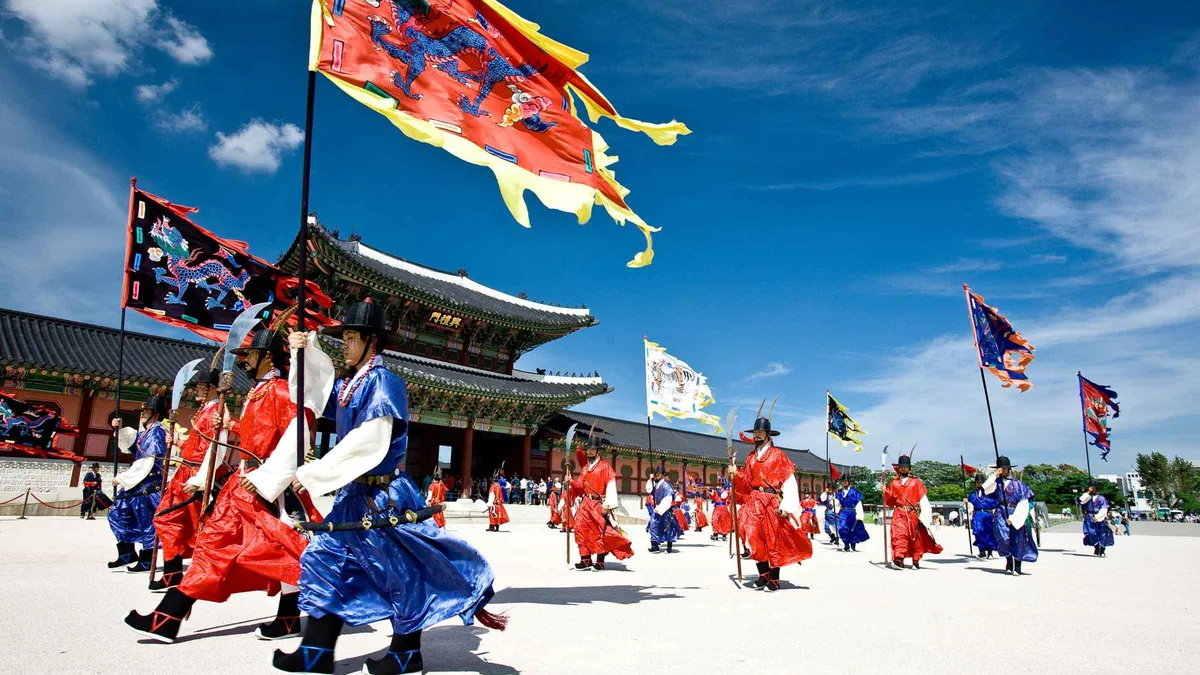 from $33
Seoul: Gyeongbok Palace, Hanok Village, and Gwangjang Tour
See the beautiful northern sides of Seoul as you visit Gyeongbokgung Palace and Hanok village. Later, enjoy a panorama view at Bugak Palgakjeong and try delicious snacks at Gwangjang.
Check AvailabilityPrices, ratings and details are the platform's own, checked in Q3 2026; dollar figures are the listed prices — the platform bills in your account's currency.
Changdeokgung Questions
Do I need to book the Secret Garden in advance?
Half the places are sold online from 10:00 six days before the visit; the other half go on sale at the palace at 09:00 on the day. Outside April, May, October and November the same-day fifty usually cover a weekday visit. In those four months, book online.
How much is Changdeokgung with the Secret Garden?
₩3,000 for the palace plus ₩5,000 for the Huwon, about $5.80 in total. The integrated palace ticket covers the ₩3,000 part but never the garden.
What day is Changdeokgung closed?
Mondays. Gyeongbokgung and Jongmyo close on Tuesdays instead, so a two-palace day has to avoid both.
How long does the Secret Garden tour take?
Sixty to ninety minutes, guided, at the group's pace on gravel paths with some gentle climbing. Add an hour for the palace before or after.
Can I walk in the Huwon on my own?
No. Entry is by timed session with a guide, and the route is fixed. This is also why a late arrival cannot be moved to the next walk.
Which English session should I pick?
10:30 for the light and the smaller group, 14:30 if you want the palace first. From March to November there is also a 15:30, which in late October puts you in the maples as the sun drops.
Is Changdeokgung worth it after Gyeongbokgung?
Yes, if you take the garden. The palace alone covers similar ground to Gyeongbokgung in less space; the Huwon has no equivalent anywhere else in Seoul.
Reviewed Q3 2026 (July–September 2026); next review Q4 2026. Prices, hours and terms are set by the venue or operator and confirmed at checkout.
We may earn a commission if you book through one of our links, at no extra cost to you. Full affiliate disclosure